Thursday, August 25, 2016

Work and Play

Its been two weeks since we have been in Ghana. It is hard to tell if Ghana is our home or New York....

After week filled with stress and hard work, we have started the week off with relaxing trip to Volta Region. It was well deserved rest but we are back in business!


This week started with the development of the Borzey House well, as well as the pump tests of both of the new wells. The Primary School has yield of 24 L/min, and the Borzey House well has the yield of 32 L/min. This gives us the total yield of 56 L/min. This yield is below our predicted yield, which could be partially accounted to the shale rock which was present at the sites instead of the predicted granite and gneiss based on the geological maps of Ghana that were available to us. We also had some difficulty with our contractors rushing to finish the wells, which caused the Primary School well to be fairly shallow (the absolute minimum of our design).


This week, we have also ventured out to Nsawam to purchase one tank for the submersible pump, as well as pipes, connectors, and all other equipment. We chose to "recycle" an unused tank by the latrines. This ordeal ended with one member of the Unit Committee going into the tank to unscrew it from its original location. He did not hesitate at all, he just disappeared inside.


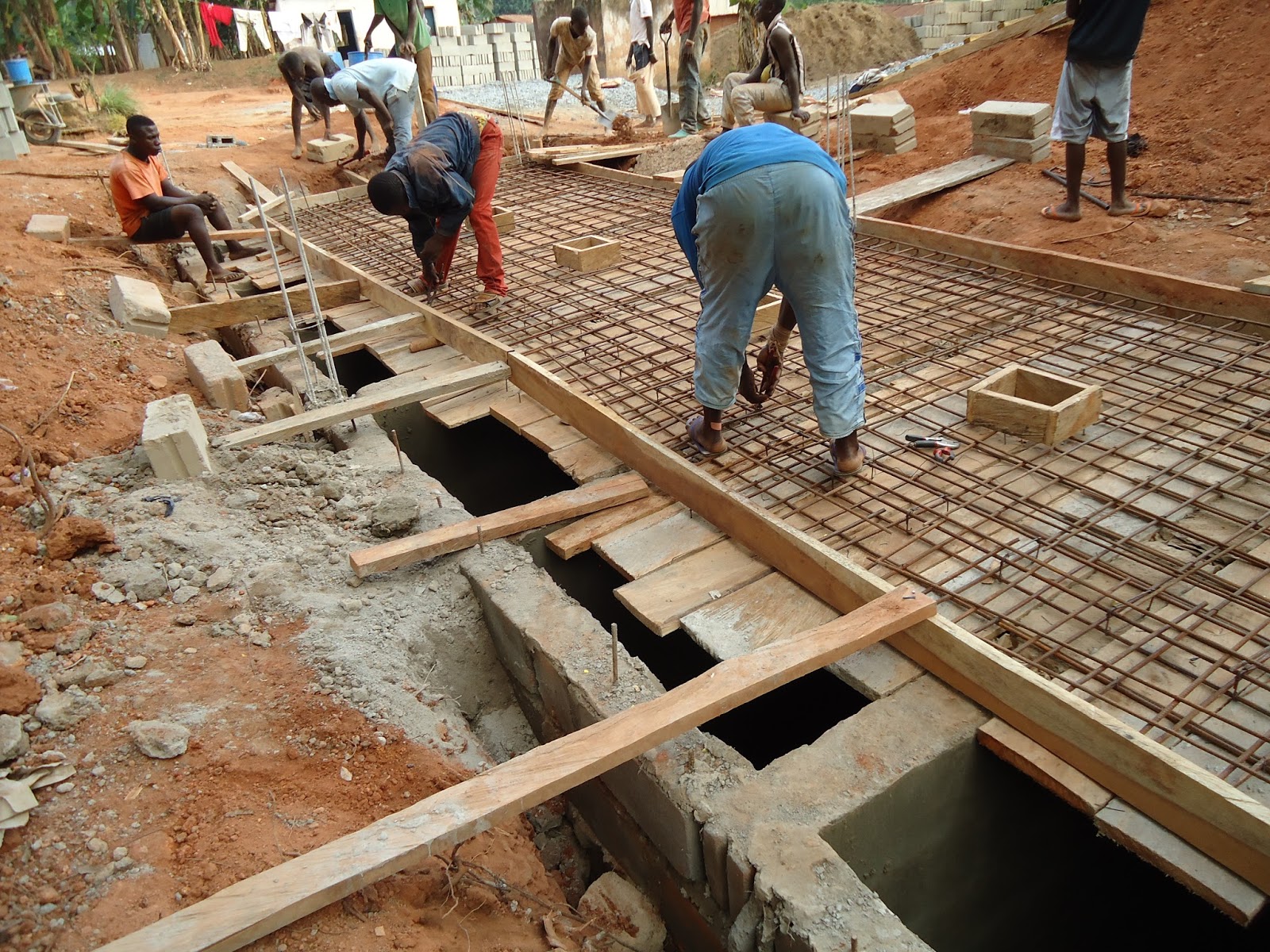
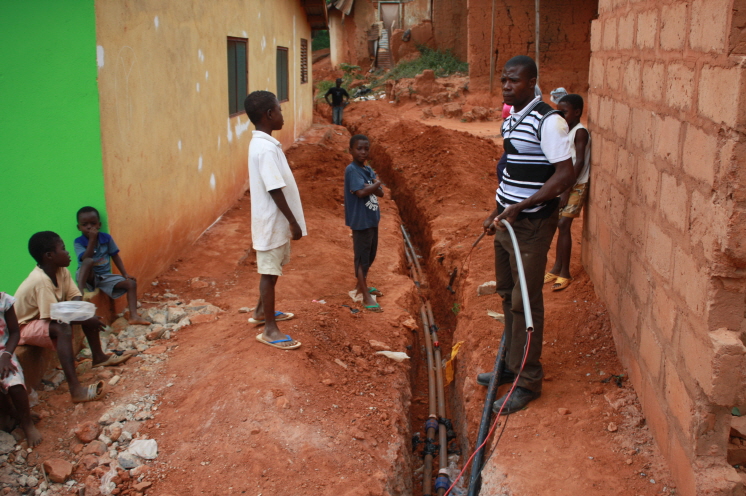
We have also constructed temporary concrete platforms for the tanks at both sites. We quickly realized that the concrete blocks were very heavy. We struggled to carry one block with two people, while the mason casually transferred the blocks from the stock to the construction site. We had so much fun balancing...I mean we did our fair share of work compacting the cement and gravel of our platforms. Yes, hard labor indeed.


(Ok we actually dug pits for the pipes)

After 6 hour deliberation with our main contractor, we have finalized and signed the second contract to install the submersible pumps for the new boreholes. Next on our radar is the Electricity Company, as the pumps will need to the connected to electricity.

Thank you for reading the update,
EWB Columbia University Ghana Summer 2016 Travel Team


Saturday, August 20, 2016

The Electric Well

It’s been one week since we arrived in Ghana, and we were joined today by the last member of the travel team, Heather Morriss, coming to us from Germany. It already feels like so much longer, and we have been truly adopted as members of the community.

On Thursday, the drilling rig arrived in Amanfrom and drilled both wells. The rig showed up early, at 7:50 am, and began drilling the Primary School Well. The drillers were using an air rotary drill, in which compressed air blows the cuttings to the top of the borehole as the drill stem advances to greater depths. As a result, the drilling process is very dusty initially, but stops once water is encountered. The drillers provided us with a shovelful of drill cuttings representing each meter that the drill stem had advanced, so that we could make observations about the geology. The children gathered to watch the drill, and screamed in excitement when the water began shooting out once the drill reached a depth of 21 meters. Water seemed to be primarily in the deeper crystalline geologic formation (most likely fractured granite or gneiss), rather than the overlying shale formation. We continued to drill until 60 meters, which was the minimum in our designs. The well was briefly developed by shooting compressed air into the bottom of the borehole, causing the formation water to rush to the surface and create a fountain of water 10 meters into the air. “Development” in the context of well construction means removing any fine particles which may have been introduced into the subsurface by the drilling process, as these particles can clog the water-bearing fractures and the well screen. Even the adults, including the EWB team, were excited to see the geyser we had created! To keep the children away from the built well, Sammy told the kids that the drillers poured electricity into the borehole, and they must stay away so they don't get shocked. This worked at first, as no one was spotted anywhere near the well while we were relocating to the second drill site.

Drilling at the Primary School Premises 

The full array of Primary School well rock


We moved to the Borzey House to start drilling immediately after developing the first well. Drilling 11:30 am. Unlike the Primary School well, we did not find much evidence of water, as the shale formation extended the full depth, and the crystalline formation was not encountered. We drilled to our maximum designed depth – 100 meters – and the borehole still had not produced flowing water, only moist intervals which could indicate the presence of water bearing fractures which have been blocked by drill cuttings. We then had to decide if we wanted to drill deeper, hoping we could get to more water, or do hydro-fracking (which was recommended to us by the contractor). We gave the borehole 1 hour to recharge, and some water did come up. We decided to drill an additional 20 meters, at additional cost, in hopes that more fractures would be intersected by the boring.

Drilling at the Borzey House

Unfortunately, following this decision, the contractor proceeded to change the screen in our design to an open borehole without consulting us.  This caused some tension between the team and the contractor, as they decided on their own to change the design of the well. The contractor failed to communicate effectively to us the reason for the design change or how it worked.  They also were rushing to complete both wells in a single day, without adequate time for communication and consideration of options.  We believe this was because they didn't want to return with the full drilling crew the second day. Luckily our technical mentor, Joelle Freeman, is a professional hydrogeologist with well drilling experience, so we stopped the construction of the well until we were all in agreement on the design. We ended up with a approving a modification to an “open borehole” below 42 meters of unslotted PVC. The end of the pipe is “fanned” out to keep washed gravel from going down to the end of the borehole. The bedrock that is exposed from 42 meters to 120 meters should have minimal fine sediments after the well is developed, allowing the water to enter the borehole and remain clear. 

In the evening, the children who had been watching the slow progress of drilling the Borzey House well, proudly announced that they had tested to see if the Primary School Well had electricity!  They all laughed so hard and said, no one was shocked, we are not afraid! So, since we were caught trying to trick them, we told them the truth, that there is no electricity, but they must not disturb the well until it is complete. We were still working after the light had gone, so the constructor left before developing the well. The Borzey House well will be developed within the next few days, most likely using the same submersible pump that will be used to conduct the yield test. We are waiting for the yield test results to finalize the design of each well.

On Friday we also ventured out to Aburi to meet with the South Akwapim District Assembly. After a long and somewhat overwhelming Ghanaian government structure crash course, we presented our designs. The District Assembly was very interested in our designs and asked insightful questions. They ensured us that they will supervise the villagers and the Amanfrom Unit Committee to make sure the system is up and running even after we are long gone. The Assembly also was very interested in forming a partnership between Columbia University and the district for further projects.

The team in Aburi

We have also briefly visited Obodan, to monitor and study the water system that the Chapter previously constructed. We were pleasantly surprised at the condition of the water system. Three years later, all parts are functioning, and vegetation has grown back to protect the pipes from erosion. We also saw that the villagers modified the spigots so they can fill their heavy buckets with water, while it is already on their heads! This eliminates the need for a second person to assist with lifting the heavy bucket from the ground.  We were very impressed that the Obodan Water and Sanitation Committee took initiative and derived such a clever solution to the problem! Engineering for the win! We also learned that the income from the fees for water from the Obodan water system (10 pesewas per bucket) has provided a reliable source of income for the Unit Committee to use towards other projects. Particularly impressive is that the money was used to raise a 5% contribution for the construction of a new Junior High School by the Blue Skies Foundation. The new Obodan J.H.S. is now one of the nicest schools in the entire Eastern Region. We hope our water distribution project in Amanfrom will be as successful, and that the income from the system can be used for future community development projects as it has in Obodan.

Thank you for reading our update,
EWB Columbia University Ghana Travel Team 2016


P.S. Ghanaian Bars are called Drinking Spots...not that I would know.

Tuesday, August 16, 2016

Greetings from Ghana!

Ete sen! (Hello!)
EWB Ghana Travel Team 2016

The first travel team (Anna Libey, Sejal Jain, Juliet Kirk, Paulina Babiak, and our wonderful mentor Joelle Freeman) has arrived this Saturday. The last few days have been very productive and we would like to share our discoveries!

For the unfamiliar with the project, the main goal for our trip is to implement two wells in Amanfrom, which will be located by the Amanfrom Primary School and at "Borzey's House," a point near the center of the village, that is easily accessible to the villagers. We are also on a mission to Obodan, the site of our previous project, to monitor the latrines built on the previous trips. Additionally, we are surveying Amanfrom for future projects.

From the start, Anna and Sejal (who coming from Mumbai arrived about 10 hours before the rest of the team) met with the Multi-Hydro Technique Ltd. in Accra to speak with them for the first time in person about drilling the boreholes for the well. They have informed us that while the hand pump is feasible, if the borehole becomes too deep, it might become too heavy to pump for children and women (the ones usually burdened with the task of retrieving water). They suggested using Submersible Pump (electrical pump which pumps all the water to the tank so people could access the water straight from the tank).

The next day, after the rest stragglers arrived, we have surveyed the sites obtained by a geologist on the previous trip, to make sure our coordinates match up, as well as show the sites to the new members who have not traveled here before. We have encountered an issue with the GPS coordinates, as the well that would be build on the Primary School premises did not match up. Immediately, we have checked the reports and contacted the constructor who performed the original survey to make sure the spot is correct (even 10 meters could make a huge difference in the well yield!).

The future borehole sites:

The "Borzey House" Site

Amanfrom School Premises Site

After the initial survey and sightseeing of the village, we had a meeting with the Council of Elders who officially welcomed us to Amanfrom. After renaming Anna to the Anan, we have presented them with our project, and insighted them with their responsibilities and the responsibilities of the community to preserve the well and make it last as long as possible. The Elders ensured us of their cooperation, and ensured us that the Water Committee will this time work to make the project possible. The meeting concluded with us taking some stylish pictures with the Elders. We plan to meet with them again next Sunday to update them on the wells, and hopefully to receive a Ghanaian names (I want one too!).

Officially handing over the project to the Village!

The Council of Elders, the Chief of the Village, and the Team.

The next day, we ventured out to Accra, to meet with Multi-Hydro Drilling Company, to drill out (haha) final details of the contract. They have agreed to just drill the boreholes for the well first, before signing a contract for pump. This allowed us to have more time to research the pumps, and contact EWB about change in our design. Our mentor, Joelle, our in country contact, Sammy, and the Multi-Hydro project managers headed to the sites to survey them for the feasibility of the track with the drill to come through. We were ordered to remove one tree branch to clear the pathway.

After the survey, we came back to Multi-Hydro and we signed the contract. MAY THE PROJECT OFFICIALLY PROCEED!

We are awaiting for the last wire transfer from EWB to start drilling.

All the best,

EWB Ghana Travel Team 2016

Friday, September 11, 2015

Latrine Photos

As promised, here are some pictures of the latrine in progress! 


Standing on top of the formwork to lay rebar for the concrete slab over the pits


 The concrete slab has been poured and cured, with six holes - one for each latrine.


The latrine stalls in progress!


 Latrine stalls with doors and PVC pipes to serve as ventilation


A side view of the latrine


Back view of the latrine, featuring Christine

A look at the inside of the pit!

Tuesday, September 1, 2015

Wrapping Up!

Hello everybody!

Christine here! The first travel team (Adam, Anna, David, Wing-Sum) left us last week to head back to New York, and our mentor Alexi left Ghana last night as well. Leerang, Becca and I are in Accra for the last few days before we leave on Thursday evening, and we have a lot to talk about!

With regards to the KVIP, we left Kwasi Doi on Saturday with high hopes for the completion of the latrine. We had a few setbacks with time and materials, but we are confident that by the time we visit one last time on Thursday before our flight, the latrine will be finished and ready for us to help paint it (pictures of that later)! We had one more maintenance meeting with the community members of Kwasi Doi, and there was a great turnout - everybody is extremely excited to have a new, working latrine. Of course, we stressed the importance of constant maintenance for the success of the latrine, and the community members agreed.  We hope that the implementation of this latrine will not only improve sanitation in Kwasi Doi, but that it will inspire the community to continue with development in the future.

We continued to work on surveying in the Amanfrom area and had several meetings with the community, where we discussed bookkeeping and reliability within the newly elected unit committee, which is the main governing body of the area. We most likely won't be building anything in Amanfrom in the near future, but we are looking forward to building a stronger partnership over the coming years!

All right, time for us to go eat dinner - we'll check in one last time before we leave New York! Thanks to everybody who has been following our trip and supported us over the last few months - your encouragement has been wonderful for all of us.

All the best,
Becca, Christine, and Leerang

Saturday, August 22, 2015

New Discoveries

Greetings from Ghana!!! The second travel team (Leerang, Becca, and Christine) arrived last Monday, and the first team (Anna, Wing-Sum, Adam, and David) left this morning. Our mentor, Alexi, is here for both travel team times.

There's been a few new discoveries about Amanfrom's current water systems. Community members told us of a borehole built in the 1990s that had worked for a few weeks but then was believed to have gone dry. To see why the borehole stopped working, we hired a specialist to open up the borehole and examine the piping. It turns out that the borehole has water in it, but that a crack in the bottom of the piping has prevented it from being able to pump water. We were really surprised that this borehole has been here the whole time unused when a simple repair (costing 650 cedis) would fix it. We've informed community leaders of our discovery and will meet with them soon to discuss plans to fix it.

We also learned of a private pump and an extension of a water source on the outskirts of the village. A nice girl named Celestina helped show us these and is excited to help us learn more. Her whole family even came by our place to pay us a formal visit. It was great to talk to them about their school and life in the village. Celestina is fourteen years old, so she has applied for high schools and will find out where she is accepted in a few weeks.

On the latrine side, construction is going well and the masons have adapted to the design changes we made to their usual latrine construction. Our community contact, Sammy, has been great about overseeing the latrine work and ensuring the construction occurs efficiently. We are excited about the technical process of building the latrine, and plan to meet more will community leaders and members to ensure that there are systems in place to maintain the latrine at a high quality.

We're looking forward to the completion of the latrine and learning more about Amanfrom's water sources, and will continue to update when we can reach internet access.

Sincerely,
2015 EWB Ghana Travel Team

Friday, August 14, 2015

Ete sen! (Eh ya!) - Travel Team 2015 Week 1

After a variety of air travel mishaps, we’ve all arrived in Ghana! At this point we’ve been here for almost a week, so this post will include a brief summary of several days worth of work.

For those of you who are not familiar with our projects, here’s a quick summary:

This trip we are hoping to accomplish two goals. The first is to implement a latrine for the community of Kwasi Doi. Our other goal is to gather information about water usage and availability in the neighboring community of Amanfrom.

We expected there to already be a hole for the pit of the latrine so that we could begin working right away. Unfortunately it’s always difficult to communicate overseas, and when we arrived in Kwasi Doi we found that the community had not started digging yet. Because of time constraints, our community contact, Sammy, had to hire a backhoe. Luckily, the backhoe was finished digging in just one day.

While the backhoe was working, we met with leaders in Amanfrom. The leaders emphasized that their first priority is water for their community, but also mentioned that in the future they’d like to have a latrine as well. We told them a little about how EWB functions, and our expectations for the community to contribute to the project as well.

One of the biggest challenges we’ve had this trip has been reaching design agreements with the workers, especially with the language barrier and because we did not communicate as well while we were still in the U.S. Additionally, we found that some of the measurements for materials such as the cement blocks are not the same as we had anticipated. We eventually came to an agreement after talking with the district engineer, and now we’re back on track for latrine construction. On the bright side, many of our larger quantity building materials cost less than we budgeted for.

Before making cement, we had to gather a bunch of water to mix into the cement powder and sand. The community’s water pump is down the hill from the latrine, and the villagers carried water from the pump to the latrine site on their heads. We wanted to help out, so each of us carried a few as well. Balancing the buckets on our head was tricky at first, but we caught on quickly. The kids and women watching thought it was hilarious that the “obroni”s (foreigners) were carrying water the way they do. They are better at it than us, but at least we were some help and it was amusing for them. We are now done with cement pouring, and will let the cement cure over a few days before beginning on the walls.

We’ve learned a lot just by interacting with the different people who live here. Our neighbor, Abraham, told us about his experiences living in Amanfrom. He told us about his job at a hotel, and also about the blackouts that they experience in Ghana. We also learned about what TV shows he likes to watch, and he taught us a few useful words and phrases in Twi (the language spoken here). He and his family have been extremely hospitable to us during our stay.

This afternoon we met with the district assembly man of Amanfrom. His name is Michael, and he also happens to be Abraham's brother. From him, we learned about the three regions of Amanfrom and how they currently get water. He also told us a lot about what the government looks like within the community, and how families are structured. Tomorrow morning, he's going to show us around a little, since we haven't really gotten a chance to see Amanfrom yet.

Our next travel team begins arriving on Monday, and we look forward to seeing them soon! For now, we hope you enjoyed our little update, and we'll try to update again in the near future.

All the best,

EWB Ghana Travel Team 2015

Monday, January 12, 2015

You've been SURVEYED!

Afwee Shepa! (still relevant, we think)

We've finally made it to the internet cafe! After navigating through a maze of Nsawam's busy streets of taxis, fruit stands (without fruit), and market hustle and becoming completely lost, we've finally collected our wits about us and used our resourceful teamwork to locate familiar territory once again to bring you this run on sentence. What a triumph!

The past few days have been full of meetings and surveys and we are brimming with new information, ideas, and motivation to begin the next stages of our projects. On the side, we've also completed the plumbing on the Central and Western latrines (2 of the main latrines in Obodan), that was not finished from last winter's travel trip. It's been a busy few days.

Our first community meeting was with Kwasi Doi on Saturday, in which we responded to the community's feedback that their latrine is low functioning with water often filling the pits. We have been faced with this issue for the past 2.5 years and cannot locate the source of the water. Thus, we've decided in keeping with our end of the bargain, it is our responsibility to provide a new, functional latrine that meets the need of the community. During the meeting, we discussed the latrine options and design criteria with the attendees for the future toilet plans. The conclusion was that the community prefers a KVIP with more seats to meet the demand of the community members.

The second community meeting held over this weekend was with Akwakupom on Sunday (nice and early at 630am). At this session, we deliberated the future of their current latrine system, which had been converted from a source-separating latrine into a lined pit latrine (similar to a KVIP) since our last travel trip. The pits on both sides of the latrine were opened a month ago due to the great demand during a funeral. The key intention of this meeting was to make the community members aware that the original functionality of the latrine was lost since the design was modified. The meeting was concluded with responsibility for the latrine's maintenance being handed over to the community.

Our final meeting was our Latrine Education Workshop with the greater community of Obodan. Here, all the posters and shoeboxes we lugged to Ghana came to use. These materials were used to explain the components of the latrine that caused the most confusion as highlighted by our surveys. We also passed around a bag of compost from the pilot latrine to show the end goal and results of source-separating latrines (beautiful black soil). The community members actively participated with questions and discussions and we are more confident than ever that the latrines are in capable hands and will be well maintained in our absence.

Today we switched gears (and communities) and headed to Amanfrom. Mike, the assemblyman from Amanfrom previously introduced, was waiting for us as we showed up at 830AM Ghana time. Mike's punctuality will definitely take some getting used to! We spent the entire day with Mike and Emmanuel, another member of the community, talking and surveying the different households through Amanfrom to gain a better understanding of how our skills can best help. Some of the problems that the different households brought up included lack of water access, lack of a secondary school in the region, and a low supply of public latrines to meet the demand of the community. We will be taking this information back to Columbia and can't wait to share it with everyone at home (who are all reading this, we're sure).

For the comic relief part of this blog post, the team decided to cook Faustina a meal to show our appreciation for all her assistance with translation work over the past week. Moral of this saga, never try new recipes with guests and Mexican-American Ghanaian fusion will not catch on anytime in the near future. However, if you don't like to see or taste your onions or tomatoes, you can hide them quite well in a stew of black beans, casava, and taco seasoning. Faustina was a delightful dinner guest and when asked her opinoin of our meal, could only muster laughter.

We'll be eating out tonight; until next time!

Friday, January 9, 2015

Angelina Poolie and Brad Pit

Afwee Shepa (still relevant, still 2015). To celebrate the New Year, we've accumulated quite the selection of tropical fruits, root vegetables, and services. As of now, we've received:
- 9 pineapples
- 7 cassavas
- 2 coconuts
- 1 puo puo (still not sure what this is as it is currently rotting under our desk)
- multiple offers of prepared food
- numerous offers of marriage
- 1 offer of a kid goat for 10 dollars
- 1 new sister-in-law for Kiersten as her brother was married off in a "love at first mention" wedding by an eager lady from Obodan

All of these goods have come as a result of the commencement of our household surveying the past few days. This Wednesday, Faustina (the sister of Assemblyman Sammy, our community contact) arrived in Obodan to help us translate our survey questions from useless English into the local language (Akwapim Twi). As of now, our lexicon consists of:
- Afwee Shepa (Happy New Year, again still relevant)
- Medase (Thank You)
- Obroni (Us, foreigners)
- Ma Chi, Ma Ha, Ma Jo (Good Morning, Afternoon, Evening respectively)
- Me Din De (My name is...)
- Other basic terms like "sorry" are still in the works. We'll update you on that later

Our Buzzfeed lists are now over, onward to the good stuff!

The surveys have proven extremely helpful in determining the work to be completed for our source-separating latrines over the next few days. These modifications are instrumental in making the latrines suit the needs of the community. Some of these needs are (last list, promise):
- converting seated seats to squatting seats
- completing piping for urine diversion
- education workshops to improve maintenance and cleaning techniques

Meanwhile, we've had a couple celebrities drop by Obodan in the form of Angelina Poolie and Brad Pit (see title). These have become some of our team members' alter egos on the front line of sampling material from our latrine "Pits". These brave visiting heroes are extracting samples from the longest composting latrine to understand the power of poo. In other words, we are using field sampling kits to understand the progress of composting waste within the latrine pits. Poolie and Pit determined that the coupling of dry conditions and feces is a powerhouse, just like them. The current compost Pit was found to be at the borderline between the Ideal Curing and Mature Compost stages. Success!

Our team has also been busy working with Amanfrom and their assemblyman, Mike, to assess their water sources and needs. From our limited first impressions, the community of Amanfrom seems super excited to work with us and to form a partnership over the next few years. We also realized they have a lot of hair salons (note for future travel trips). The first step after this past Sunday's community meeting was to collect water samples from all six utilized water sources:
- Anofo Stream
- Tonto Stream (potentially a spring)
- Nana Obodan River
- Amoani Spring (that has catfish that look delicious but are according to the community members, essential to the spring's existence, and therefore are taboo to catch and consume)
- Primary Well (hand-dug)
- Cemetery Well (EWB's nickname, also hand-dug and taboo to use)

These water samples are being tested AS WE TYPE in Accra for coliform and inorganics. We are also testing the water system in Obodan for coliform (samples taken at the spigot by the pump, the borehole, and the pump inlet). We anticipate these results by next Thursday, watch out for them!


tl;dr
Water Testing/Sampling happened
Poop Testing/Sampling was gross but informative
Surveying was good
Pineapples


Monday, January 5, 2015

The Day(s) Without an End(s)

Afwee Shepa! (Happy New Year- in twi!) We are so excited to be here in Obodan and work with our partner communities. Today is our third day in Ghana. We got here on Jan. 3rd, and had a very exciting and productive first day! After settling in to our room in the Obodan community center, we met with Obodan's assembly man and longtime EWB community contact, Sammy Gamson. After catching up with Sammy, we went to a party in Fotobi. The party turned out to be a young woman's graduation event. After being set down in literally the spotlight of the party, the MC came up and suddenly we were the center of attention during this girl's celebratory party. We made the (ultimately positive) mistake of saying that our favorite Ghanaian song was Azonto (which is awesome) and then were brought reluctantly on stage to dance for it. After a heroic attempt at dancing with grace and poise, we were eventually, mercifully joined by children who taught us how to dance unterribly (for the most part!).

After the party we met with Sammy and our mentor, Steve, to talk about our projects and plan for the next two weeks. Then we received our mattresses, went back to the community center, and finally went to bed. After being up for 36 hours at that point, we fell asleep within 36 milliseconds of our heads hitting our pillows (stolen from the plane!). A well deserved nights sleep!

DAY TWO:  After an early rise to prepare for a full day of meetings, the travel meet met with Obodan's brand new Unit Committee (formally known as the water committee). We had a very productive meeting discussing Obodan's water distribution system, going over our shared concerns and goals for our future projects, and going over new programs to improve the latrines, including the implementation of a latrine ambassador program. The unit committee seemed very enthusiastic about the program and eager to take a role in latrine affairs as well as water distribution things.

Then we met with the Amanfrom community, who voiced to us with much enthusiasm that their biggest concern is water. We went around to all of their water sources and spoke with community leaders about the steps we need to take to decide whether we can help with their water availability. Then we went to Fotobi for food and drinks!

DAY THREE: After yet another early rise, the team went to collect water using buckets and carried them on their heads for the first time. We looked at the latrines in Obodan and Alata, and then went to Akwakapom and Kwasi Doi to meet with the communities and look at the latrines. It was a great day!

Saturday, August 16, 2014

Hi everyone,

Though ebola has not been confirmed in Ghana, Columbia's emergency insurer has unfortunately decided that it would not be able to handle a medical emergency in West Africa because of the policy of restricting or canceling flights in affected countries.

This unfortunately means that the August 2014 monitoring trip has been canceled. Luckily all of the team was notified before arriving in Ghana, though some of us were on the first or second of a string of connected flights and are now preparing to return.

-Lucas

Friday, January 17, 2014

We're writing this from an internet cafe in Accra before Emma and Roshan leave on their flights out of Ghana! The past two days have been spent gathering information at Fahiako and Amanfrom, two communities near Obodan that have reached out to us for help. Fahiako's top request is the construction of a health clinic. This relatively isolated town lacks both clean water and electricity, but after talking to nurses at Pokrum Health Clinic near Obodan, we learned that it is entirely possible and even common to have clinics without electricity. As long as a borehole with clean water can be dug, the project could go forward. Currently, sick and injured community members have to walk of be carried for miles to the nearest clinic. The cell service is extremely spotty, and it is rare that a cab can ever be called. We are considering connecting the village with a professional chapter which has more resources and experience in the clinic area. We also talked with community members in Amanfrom, where the people requested easier and increased access to water. Currently a village of about 1,600 is subsisting off a small pool and a single hand-dug well. We surveyed the community  area and its water sources. Further consultation back at Columbia will determine whether and when we decide to help this community.

Wednesday, January 15, 2014

This past Sunday we had a community-wide latrine educational workshop. We advertised it at our household surveys for days in advance, telling people that the meeting would start at 3:30pm, and knowing that people would begin to show up, at best, around 4:30pm. The day of, we went house-to-house to rally people, and got a very decent turnout of at least 30 women, men, and children of all ages. Using several hand-drawn cartoons and diagrams courtesy of Emma, we discussed maintenance, the purposes of lined, source-separating latrines, and prompted a dialogue amongst community members about latrine issues that have come up. We passed around soil samples recently collected from latrine pits for further visuals. It is difficult to immediately gauge the effectiveness of our workshop. Future monitoring will show if latrine maintenance improves. This trip's educational initiatives have been the largest in the history of our latrine project, and we have directly reached scores of community members. Hopefully our efforts will have a positive impact.
      On Monday, we had time to take a day trip to Lake Volta. Cruising amongst marshy islands, the chemical engineers on the travel team couldn't help but make comments on the laminar and turbulent flow of the water around the boat. Even on our free days, some of us are still very much engineers without borders.
    We visited a neighboring community today that has reached out to us for help in constructing a health clinic. Unused latrine pits were also sealed this afternoon. Tomorrow we plan on meeting with the community leaders of Amanfrom, another community that has expressed interest in receiving help with infrastructure improvements.
   

Thursday, January 9, 2014

It's your favorite CU EWB "obronis" (foreigners in Twi, our perpetual nicknames) reporting as we complete our first week in Ghana. First, we have some exciting breaking news: Radhe Patel is our new EWB USA New York City Metro Representative! She just received the email from an internet cafe in Nsawam where this blog post is coming from. Congrats to our fellow travel team member!
       On a more project related note, we have encountered both challenges and breakthroughs in the past days. From soil tests we performed several days ago, we found that some of the source separating latrines we implemented are producing "untreated organic fertilizers" or compost in a moderately active stage of development. Because we planned to prescibe use of latrine compost for trees and non crop plants, this is wonderful news! It appears that the community has been able, on a moderate scale, to turn their waste into
usable compost!
       Community members were pleasantly surprised when shown samples of this compost. Based on these results, we plan to help the community remove the compost from beneath the first latrine we built in Obodan,
commonly known as the pilot latrine. Although the contents of the pit are not ideal compost, we will use it as an educational initiative to show what is possible and what can be improved.
       Speaking of education, that has been a major project in the past days. We have been conducting household surveys by asking for feedback about the latrines and new water system, and assessing the effectiveness of the projects. Despite the moderate success of some of the latrines, there has been suboptimal maintenance, including clogs and insufficient cleaning of the toilets. We have also learned some problems that community members have with latrine design. Our goal is to help the community meet their water and sanitation needs as effectively as possible. Part of reaching that goal is understanding how we can best assist the community, and part of it is making sure they can maintain it independently, reaping the benefits for as long as possible and taking their own initiative to address issues. All EWB projects are, after all, community owned. These house to house surveys have helped us reach a myriad of community members who are directly affected by the infrastructure systems. We have engaged in dialogues with everyone from old women to young boys, and feel that the information we have gained and shared will positively affect the projects.
       We are currently working on ways to address the problem of a perpetually flooding latrine pit. Through talks with the commuity and the cheifs, as well as assessment of current sanitation infrastructure, we will come up with short term recommendations for the community and long term action plans for ourselves.

Sunday, January 5, 2014

Mma ajo! We're nearing the end of our third day in Ghana, with a greatly expanded Twi vocabularly, new Azonto dance moves, and an increased resistance to the smell of human excrement! We spent the first day recovering from a very long trans-Atlantic flight, and started early the morning of the 4th with a scenic, hour-long walk from our lodge to Obodan. Along the way, we were given two pineapples by field workers. We ate them like corn on-the-cob, and they were the most delicious fruit an of us had tasted in a while. We spent the day doing soil tests of the contents of our source-separating latrines. Fashioning "shovels" from long sticks and cut bottles, we braved the stench and the flies to take fresh latrine samples. Our tests confirmed that at least one of our latrines is producing usable fertilizer! That night, we met with the Water Committee and got a better understanding of the success of the water system thus far, and how the community was taking responsibility for it and fixing problems that have arisen.
    We rose bright and early this morning for an 8am meeting with the Queen Mother and various village chiefs. More latrine soil tests and water quality tests followed. Throughout the day our moral was boosted by Ghanaian music blaring from an impressive sound system rented for a naming celebration. This evening we held a community meeting that was attended by scores of community members. We were able to gauge their understanding of the process behind source-separating latrines, their plans for the future, and issues they have been having. It was a great dialogue amongst the community members! We hope to have more of these meetings, and another educational workshop in the next week.
    After dinner at McDonalds (which is not the golden double arches McDonalds I know you're thinking of---we got chicken and rice). We're feeling ready for more community surveys and water tests tomorrow.

Thursday, January 2, 2014

Travel Team Leaves for Ghana!

We are at JFK now boarding our flight to Accra, Ghana connecting in Lagos, Nigeria. We're super excited!

Sunday, September 1, 2013

Implementation Success!

­­­­Hey everybody! Erin, Christine, and I are sitting at the Addis Ababa airport waiting for our flight to London and then finally to New York. After over a month spent in Ghana, our travel team has finally completed the Obodan water distribution system! The roadblocks and challenges seemed endless, yet our dedicated EWB group, with the help of contractors, village members, and countless children in the community, constructed a working water distribution system for Obodan. Even in the last couple of days with the system working, it seems like a huge success. The community spends less time and effort in fetching water. They don’t have to use a hand pump to have water anymore and many in the community now have water significantly closer to their houses. When I first got to Obodan and saw all the work that we had to complete, I was skeptical that the project would get completed. After all those months and long hours both working on the design of the system and the implementation, EWB-Columbia, Ghana chapter completed this project.

Some group members and the community while Lucas inspects the spigot

I think the most important and memorable day for me is when the water finally started flowing. Last Wednesday (8/21/13), the pump supplier finally installed the pump and we connected it to the system and got water! This week started out very stressful. First off, Electric Company of Ghana took forever to connect to the grid. Eventually Christine and Lucas had to go to their office in nearby Nsawam to pay them and have them sign a contract saying that they had to complete the task by the end of the day. It was an especially stressful day because had ECG decided to come in two weeks like they originally planned, our project would not have been finished in the allotted time we had. Once the electric company came, they couldn’t connect to the grid because the other electricians that we hired had made a single-phase electrical setup instead of the necessary triple-phase. This required them to come back the next day once it was fixed. Luckily, they did come the next day which allowed for water that day!

One of the first times using water

Of course, the problems didn't stop there. Once we filled the tanks up all the way, we found leaks, leaks, and more leaks at the tank connections. We had to fix these and once we fixed these there were still a ton of leaks. The leaks stemmed from not having quality made tanks that matched up perfectly. Eventually, on the third try, we fixed all the leaks and the system ran smoothly. The other work involved was building masonry over the exposed pipes near the well in order to deter theft and protect the pipes from weather conditions, and building concrete slabs for each of the spigot locations so that the ground wouldn't become like a swimming pool.  We also shocked the water table and both tanks with chlorine so that the drinking water would be cleaner. After all these steps and some other minor fixes, the system was complete!

Christine, Erin and Robbie at the tanks

Now as a chapter we face a crossroads. We have to figure out where our chapter should go next. Obodan has developed a lot since we started coming there about eight years ago. Other communities in the surrounding area face many more problems. For example, in one community they only access to water involves using a hand well that often dries up or walking ½ mile to a river that frequently dries up as well. The team members in Ghana are all really excited about taking a new engineering challenge and helping to improve the lives of another community. We have decisions to make that could lead us to stay in Ghana or possibly a new place like South America or anywhere else that has a need that our chapter could help solve.   
Erin at a finished spigot

Thanks to the students who helped with implementation: Mira, Lucas, Kofi, Leerang, Erin, Christine, and Robbie and to the mentors: Kelly and Martin. Also, thanks to all the EWB students who helped with grant writing, fundraising, the design, and all the other tasks that were essential for a successful project and finally to all the other mentors that helped guide us throughout the project.  Lastly, a huge thank you to Sammy, the local assemblyman, who helped us with everything we needed once we were in Ghana. This project could never have been finished without all of your help!

Some of our group with Sammy

-Robbie

Day 20 - 27: Final Step!

 On August 20th, we entered the final stage of our implementation: pump and float switch installation. In the morning, Wise Water Engineering came to install the float switches and lay out the wires from the borehole to the tanks. However they ran out of the wire and conduits, so they headed back to Accra to buy more materials and had to come back the next morning. Meanwhile, the Electric Company Ghana came and made connection to the electrical grid.
Wise Water Engineering laying out the wires for float switches

ECG connecting to the electrical grid

 August 21stwas a big day, because all of our contractors came. Borehole remover arrived first at 6 a.m., and removed the hand pump at the borehole. Then Wise Water Engineering came to finish the wiring. Following was the AKO Engineering who came for the initial installation of pump. When the pump was installed, we pumped up the water for the rest of the day so that we could fill up the tanks.
Borehole specialist removing the hand pump

AKO Engineering installing the pump
Water pumping out from the pump!

 Next morning, AKO Engineering came back to uninstall the pump so that we could shock the borehole with chlorine. While the borehole was shut down for cleaning, people could use the water from the tanks. After the shock, AKO reinstalled the pump and the control box.
 It was also the first day that water finally came out of the spigot. It was also Chrinstine’s birthday, and her uncle gave us a box of cupcake and four boxes of pizza.
Shocking the borehole. We put the chlorine in the water bottle
 with gravel and send it down through the borehole
 After the pump installation was complete, from 8/24 to 8/27 we mainly worked on fixing the leakages, making the concrete slab around the spigot, and building the masonry wall around the pump to protect the pump. There was a big leakage on the tank which took many hours to fix, but we eventually made it work. Meanwhile, Lucas and Leerang visited Amanfrom and Fahianko to look around other communities. In both communities people are having a major problem with getting clean water.

Building the spigot slab
Building the masonry wall around pump


Tank connections

People fetching water from stagnant pool in Amanfrom

 Once the spigot slab was cured, people all started fetching water! We had a meeting with a water committee to go over the operation and maintenance manual, and talked about how to collect money from people. We had a nice team picture with Sammy and Obanzu before Lucas, Martin, and Leerang headed back to U.S.

People fetching water from spigot!
Water Committee 


Team Photo!

Thursday, August 29, 2013

Days 9 - 19: Setting up pipes and tanks

The past 10 days have been dedicated to setting up the piping, tanks, and spigots, so that as soon as the pump is installed, water can be pumped up to the tanks from the borehole and accessed at the spigots. As always, the work has been grueling but rewarding. Christine, Erin, and Robbie joined our team in Ghana on the 12th. 

Here, Christine is carrying gravel to put into the trenches to stabilize the pipes.

Erin and Robbie clear the trench of debris before laying the pipe down.

Robbie works on cleaning and gluing PVC pipes together.

Erin carries PVC pipes from the storage location in the chiefs' palace to the worksite.

The piping is almost complete - just one more PVC length until we reach the tank connection .

Robbie, Christine, Mira, Sammy, Lucas, Erin, Leerang, and Kofi stand proudly before the fully connected tanks.

We were unable to find valve boxes (apparently these are not made or sold in Ghana) so we improvised them out of 6-inch HDPE pipes and PVC pipe caps. The kids figured out that our "valve boxes" made excellent drums and serenaded us all afternoon.

Wise Water Engineering, our electrician contractors, installed the meter board for the power supply. Here they are installing a copper grounding rod, using water and a hoe to dig the hole for the rod. 

Mira, Christine, and Erin were invited to speak at the girls' secondary school in Obodan. We explained the project we are working on in Obodan, and then we encouraged the girls to study hard in school, especially math and science, in order to bring development to their own villages. Hopefully we've encouraged some of the girls to become engineers like us!